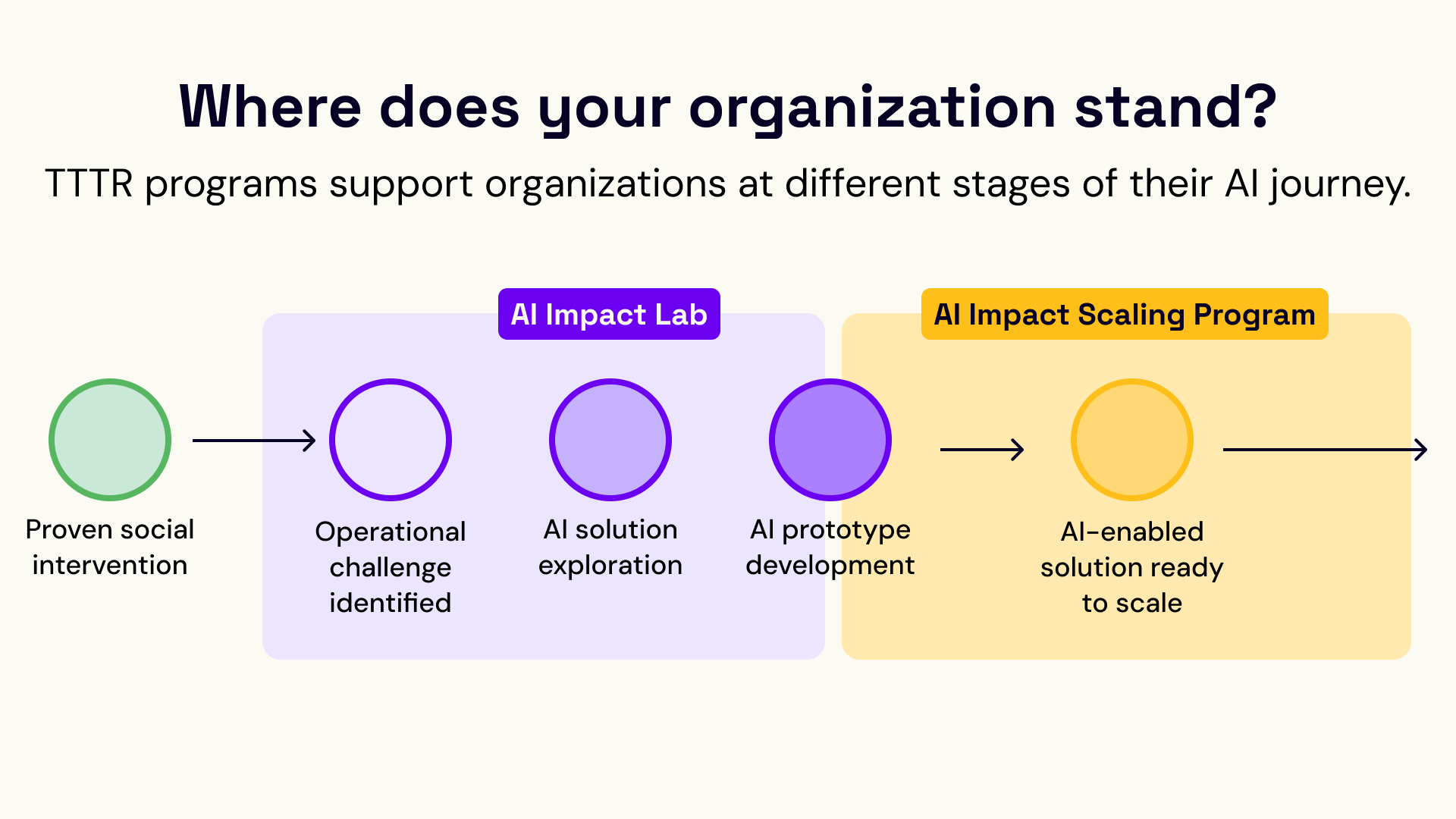
Tech To The Rescue works with social impact organizations that want to strengthen or scale their interventions through technology and AI. Our programs support organizations at different stages of that journey. Applications are reviewed against a set of criteria that help determine whether an organization is ready to prototype a solution or scale an existing one.
Every TTTR program begins with a social intervention that already works. Before technology enters the picture, the intervention needs to demonstrate real outcomes for the people it serves: a clear description of what the organization does, the population it supports, and evidence that the model holds up in practice.
We look at whether the intervention is already running in the field or has academic validation, whether it produces measurable results, and whether the organization has the operational structure to sustain it.
Technology and AI come in to strengthen and extend that work. They don't define what the intervention is.
Organizations that are still developing their model are encouraged to return once the intervention is more established.
The two programs serve different stages of AI readiness. The AI Impact Lab is for organizations that have a clear problem and want to build their first AI solution. The AI Impact Scaling Program is for organizations that already have a working solution and want to expand its reach.
AI Impact Lab: for organizations preparing to build their first AI solution
The AI Impact Lab takes a clearly defined operational challenge and turns it into a working AI prototype. If your organization knows what problem it wants to solve but hasn't yet built a technical solution, this is the right starting point.
Problem definition and AI fit
The application should describe a specific operational challenge that affects your intervention's performance, grounded in day-to-day experience and connected to measurable constraints. We also look at how you explain AI's role in addressing it.
Expected impact
What would improve if the solution works? This might mean reaching more beneficiaries, reducing operational time, improving service delivery, or strengthening decision-making. The application should connect the proposed solution to concrete improvements in outcomes.
Data readiness
Building an AI prototype requires relevant data. Applicants should describe what data exists, where it comes from, and how it relates to the challenge. Awareness of data protection and responsible data use is part of the review.
Leadership, ownership, and execution capacity
Lab projects require real internal commitment. We look at whether leadership is actively engaged, whether someone inside the organization owns the initiative, and whether there is enough technical capacity to support prototype development. Organizations should be prepared to dedicate time to the work throughout the program.
The AI Impact Scaling Program supports organizations that have already developed a digital solution and want to grow its reach through AI. The starting point is a working prototype or functional product. The program helps you move from a solution that works to one that works at scale.
Scaling ambition
The application should explain how you plan to expand the intervention's reach and what role AI plays in that expansion. The strongest applications connect scaling goals to measurable outcomes and show a realistic path to achieving them.
Demand and distribution readiness
Scaling requires evidence that the need exists and that viable channels are available to reach more people. Applicants should show signals of demand and describe how the intervention could grow, whether through partnerships, institutional relationships, digital platforms, or existing distribution networks.
Execution capacity and sustainability
The application should demonstrate clear ownership of the project, sufficient capacity to manage implementation, and a realistic plan for keeping the solution operational after deployment.
Data deployment readiness
At this stage the solution needs to be production-ready. That means clear data governance, awareness of privacy and security requirements, and readiness to responsibly operate a live AI system.