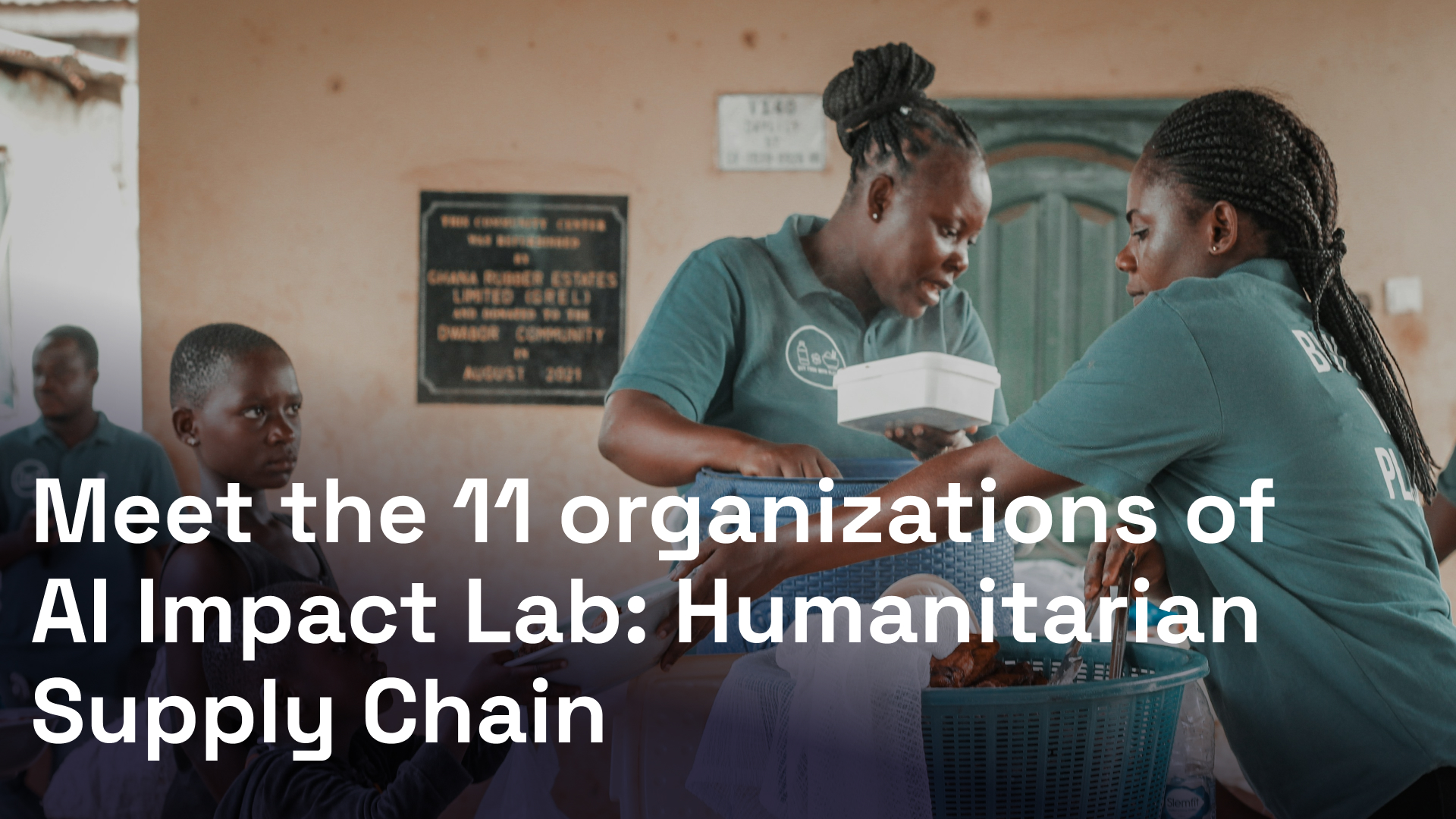
Eleven local and national organizations from across the Global South, running humanitarian supply chains in some of the world’s hardest operating environments. Each with a specific bottleneck, a team ready to work on it, and data to build with. This is the cohort of AI Impact Lab: Humanitarian Supply Chain, made possible by HELP Logistics.
Somewhere right now, a logistics coordinator at a small humanitarian organization is manually cross-referencing three spreadsheets to figure out which supplier can still deliver. The answer exists somewhere in their data, but getting to it fast enough is a frustrating challenge. What’s even worse, the delay has a very tangible cost and affects people’s lives.
That is the gap this cohort is here to close.
In 2025, the humanitarian sector had one of its hardest years. Funding dropped. Global logistics hubs that organizations had relied on for years became less predictable. Teams were asked to serve more people on smaller budgets. The organizations that kept going knew exactly which part of their work was slowing them down.
We opened applications in June 2026, together with HELP Logistics, an operational nonprofit initiative of the Kühne Foundation with twelve years of supply chain work across humanitarian, development, and climate contexts. Organizations from across the Global South applied. Eleven made it through. Selection came down to one question: could the organization name a specific bottleneck, show they had data relevant to it, and put together a team ready to work on it?
These eleven could. Over ten weeks, each team takes that bottleneck and builds an AI prototype to address it, with mentorship from HELP Logistics supply chain experts and Tech To The Rescue’s network of AI practitioners. The program costs nothing for selected organizations. It ends with Graduation Day on 23 October 2026.
Eleven countries, one shared problem
The organizations in this cohort work in Sweden, Kenya, Syria, Jordan, Vietnam, Yemen, the Netherlands, Thailand, and India. They serve displaced families, patients in fragile health systems, communities recovering from disasters, and people who depend on food banks to get through the month. What they share is the same frustration: the information they need to make better decisions exists, but reaching it takes longer than it should. Every extra hour matters.
Distribute Aid is a volunteer-powered humanitarian aid team. Last year they completed 46 shipments and delivered 2.2 million aid items worth $3.95 million. When a disaster hits, frontline groups send their needs in voice messages, quick texts, and informal calls. Nobody fills out a careful form when communities are in crisis. Turning those real-world messages into clean procurement data is slow, manual, and does not scale. Distribute Aid is building an AI tool that reads how people actually describe their needs and converts that into data the team can act on. The target is to cut initial delivery times from eight days to four, and save 460 staff hours a year currently lost to reporting. The board has always been women-led.
inSupply Health works on health supply chains across East Africa, currently focused on a forecasting problem in Tanzania. Every year, more than 8,000 health facilities submit their commodity needs for the national planning cycle. The data that comes back is full of errors: typos, duplicates, missing items. A facility that typed 1,000 instead of 100 changes what the whole system orders. Fixing it manually takes time and advanced Excel skills, and tired reviewers miss things. inSupply Health is building an AI system that catches these errors automatically, so Tanzania’s health system makes purchasing decisions based on what facilities actually need. Women hold the majority of senior leadership positions.
Better Shelter makes modular shelters used by displaced communities in humanitarian operations around the world. The shelters work differently from local construction methods, which means field teams in unfamiliar environments, under time pressure, sometimes get the assembly wrong. The guidance to do it right already exists, spread across manuals, training videos, emails, and field reports in several languages, but pulling the right information at the right moment is harder than it should be. Better Shelter is building a multilingual AI tool that gives field teams clear guidance in their own language and knows when a problem needs a human expert rather than a knowledge base.
Basmeh and Zeitooneh was founded in 2012 by Syrian refugees in Lebanon. The organization is refugee-co-led and runs programs across Syria and Lebanon in emergency response, protection, education, and livelihoods. For their Return with Dignity program in Homs, every procurement document has to be downloaded, manually signed, and re-uploaded through a multi-step approval chain that crosses two countries. At the same time, staff cannot see in real time how much budget is committed, approved, or still available across projects running in parallel. Both problems slow the time between identifying what a returning family needs and actually delivering it. They are building an AI procurement tracker that routes approvals automatically and answers budget questions in plain language.
Tkiyet Um Ali has delivered over 2.3 million food parcels and reached more than one million people since it was founded. Today the organization delivers monthly food parcels to more than 22,000 families across every part of Jordan, with additional programs in Gaza. Managing that at scale, confirming deliveries, checking eligibility, collecting feedback, is almost entirely done by hand. Staff process each household individually. They are building an AI system to handle the routine communication, route the edge cases to a person, and give staff their time back for the work that genuinely needs them. The organization was referred to the program by the HELP Logistics.
Food Bank Vietnam runs a national food recovery network across 25 warehouses, collecting surplus food from supermarkets and restaurants and redistributing it before it expires. Stock levels, expiration dates, donation sources, and beneficiary organizations are tracked across disconnected spreadsheets and messaging apps, and a good allocation decision requires cross-referencing all of them at once. That takes time the food does not always have. They are building a centralized data system with AI-assisted inventory tracking so that when a donation comes in, everything needed to act on it is already in one place. This was a HELP Logistics referral.
Building Foundation for Development manages the distribution of medications to patients at public health facilities across Yemen. Tracking what gets dispensed, monitoring inventory, and generating reports happens through fragmented manual processes. The result is data gaps that make stockouts almost impossible to anticipate before they happen. In a humanitarian health context, running out of medication is not a logistics inconvenience. BFD is building an AI system to automate last-mile reporting, improve inventory visibility in real time, and eventually support demand forecasting so the team can act before a facility runs short. The organization was recommended by HELP Logistics’ Middle East team.
Violet manages humanitarian procurement across multiple sectors in Syria: supplier quotations, contracts, compliance documents, market research, all reviewed and processed by hand. When an emergency response is running, that workload slows everything down. Violet is building an AI procurement system that reads documents, compares supplier offers, flags compliance risks, and gives the team a recommended course of action, while keeping a human in every final decision. The approach addresses a challenge common across the region and could be adapted by other organizations facing the same problem.
Boxtribute builds free, open-source logistics software that helps small humanitarian organizations manage and distribute aid more effectively. For every new geography or partnership, the team manually researches who else is working there, who has funded similar work, and what has already been tried. The knowledge exists but lives in past conversations, documents, and individual people’s memory rather than anywhere searchable. Boxtribute is building an AI system that pulls from their internal and public sources to surface relevant information, with citations so the team can verify what it finds. EY supports their participation in the program.
Suwannimit Foundation works with communities along the Thailand-Myanmar border. Their supply chains cross a conflict zone: armed clashes, road closures, checkpoint changes, and communication blackouts can make a route that worked yesterday unavailable today. When that happens, staff have to manually gather information from spreadsheets, messaging apps, and colleagues to build an alternative plan. Every minute spent on that search is a minute the delivery is delayed. They are building an AI decision support system that keeps a live map of supply chain resources and generates alternative options when something breaks down, with all final calls staying with the team. The foundation is refugee-led.
GOONJ runs a circular supply chain across India, collecting urban surplus including furniture, clothing, medical supplies, and assistive devices, and turning it into dignity kits and community goods distributed through Centres of Circularity. Every donated item needs a decision about where it goes, in what form, and when, based on community needs, inventory, and logistics capacity. Right now those decisions are made manually. GOONJ is building an AI classification and matching tool to support those routing decisions, so more of what comes in gets used well and reaches the communities that need it most.
From prework to prototype in ten weeks
Prework runs through late August, giving every team the same foundation before the bootcamp starts. The seven-week AI Bootcamp opens on 31 August and closes with Graduation Day on 23 October. Around 80% of bootcamp time is dedicated to workshops and hands-on work on each team’s own challenge, alongside organizations working through similar problems in different contexts.
Teams that finish with a working prototype and a clear implementation path can apply to continue into the AI Impact Scaling Program, where they are matched with a pro-bono tech partner for twelve months to build the full solution.
HELP Logistics experts will be involved as mentors and lecturers throughout, bringing supply chain experience from projects across Africa, the Middle East, and Asia. We will document what we learn from this cohort honestly, including what does not work.
A free ten-week online program for local and national organizations running humanitarian supply chains in the Global South. Each team identifies one operational bottleneck they already understand, and spends the bootcamp building an AI prototype to address it, with hands-on support from HELP Logistics supply chain experts and Tech To The Rescue’s network of AI practitioners. The program runs from 31 August to 23 October 2026 and is made possible by HELP Logistics, an initiative of the Kühne Foundation.
Tech To The Rescue designs and delivers the program. HELP Logistics provides the anchor funding, co-designed the selection criteria, and contributes supply chain expertise through mentors and lecturers throughout the bootcamp.
Each organization leaves with a working AI prototype, a practical AI implementation strategy, and a team that has spent ten weeks learning by doing. Organizations with strong prototypes are invited into the AI Impact Scaling Program, where a matched pro-bono tech partner helps them build the full solution over twelve months.
Applications for this cohort are closed. Follow Tech To The Rescue on LinkedIn or sign up to the newsletter to hear when the next call opens.