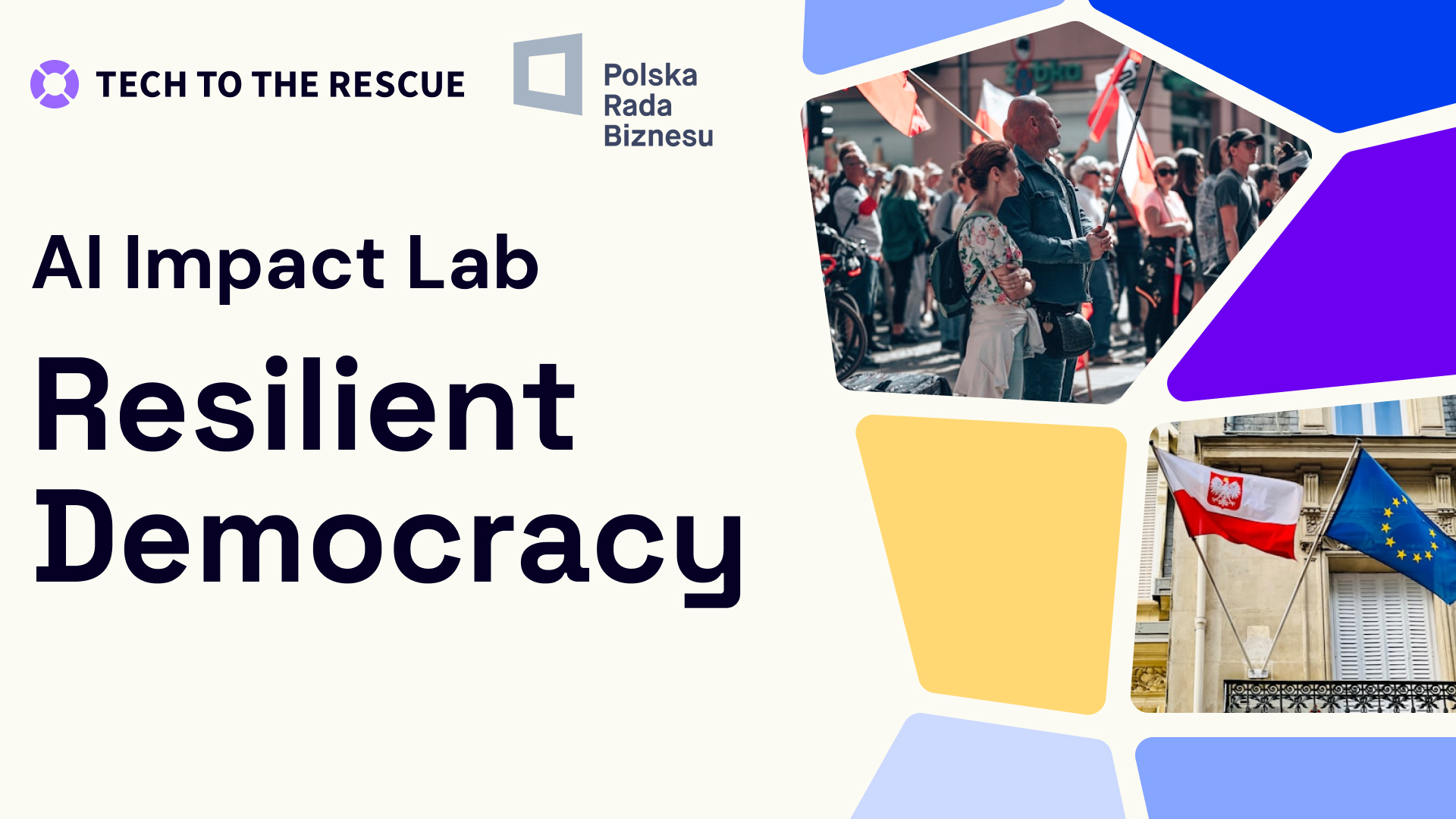
Democracy is never secured for good. Fifteen Polish organizations are using AI to keep building it, on their own terms.
Democracy is not something a country secures once and keeps forever. It is built every day, by people and organizations who engage citizens, counter disinformation, create space for honest debate, and rebuild trust where it is missing. This is the work that keeps Poland's place in a united Europe standing on solid ground, and it does not happen by itself.
Polish civil society organizations have been doing this work for years. They have proven solutions and know what actually works. What they don't have is the capacity to reach everyone who needs them. Demand for their work is growing while budgets shrink in real terms, against the fastest pace of technological change in history. Used responsibly, AI gives them a real chance to reach further and work more effectively. That potential does not realize itself.
We reached out to more than 200 organizations working on democracy and civic trust in Poland. Twenty-four applied. Fifteen made it through. Selection favored precision over polish: how exactly an organization could name the bottleneck AI might solve for them, regardless of budget size or pitch deck quality.
These are organizations that have carried the often underappreciated work of democracy for years, sometimes decades, often with processes that have not changed since the day they started. They showed up with a specific, limiting process and a real question about whether AI could change it.
Three weeks of Prework built from scratch, in Polish, so every team enters the Bootcamp from the same starting point — without losing time on the basics.
Then seven weeks of intensive, hands-on AI Bootcamp, with a 2.5-day in-person session at the Polish Business Roundtable Foundation’s headquarters in Warsaw at its heart. For the first time, we’re bringing the whole cohort together in one room — and that’s where feasibility turns into real prototyping: vibe coding, AI agents, UI/UX, synthetic data, debugging, and governance — including kill switch design, because responsibility has to be built into the prototype from day one.
On top of that, experts co-developing Bielik.ai — a family of open-source AI language models built by the SpeakLeash Foundation for European languages — will lead a dedicated session, and twelve experts from their community, from companies including LOT Polish Airlines, Docplanner, and CSHARK, will mentor our organizations directly.
The opening session was led by Krzysztof Izdebski from the Stefan Batory Foundation and Michał Mazur from the Centre for Citizenship Education — we talked about where democracy in Poland is most vulnerable today, and how AI can either strengthen it or deepen polarization and disinformation. The second session is the most honest part of the program: what we regret, what we’ve learned, and which decisions really cost us the most when building with AI.
Because it’s the only program designed specifically for social impact organizations that ends with something real — a working prototype and a concrete AI implementation strategy. Not another workshop you leave inspired but empty-handed.
And no one does this alone. This cohort is a community of organizations that experiment, make mistakes, and learn from each other — because that’s the whole point.
Because a prototype is just the beginning. Without an implementation strategy, even the best tool ends up on a shelf — no adoption, no impact, no scale. That’s why every organization leaves the program not just with a prototype, but with a written AI Solution Strategy — a plan that can actually be implemented. And for those who want to go further, we’re opening the door to our 12-month Scaling Program with a pro bono tech partner.
is fixing a training system that has used the same 176-slide deck for eleven years to prepare Poland’s electoral commission members, a group that can number 250,000 people per election and will be on the front line in 2027. Their existing materials were downloaded more than 20,000 times before the 2023 parliamentary vote. They want AI to keep that content current when election law changes mid-cycle, something the current static model cannot do.
is building a tool to trace which public comments actually shape Polish legislation, work that currently takes a small team four days per bill because the source documents are scanned, unstructured, and often hundreds of pages long. They are aiming to cut that to four hours.
already monitors 200,000 to 500,000 public posts a month for hate speech and coordinated disinformation, with around 200 cases a month reaching expert review. They want AI to catch the coded, ironic, and rapidly shifting language that keyword filters miss, and to free up expert time currently lost to manual evidence collection.
runs an anti-violence helpline that took 13,300 contacts in 2025, staffed ten hours a day by psychologists. Anyone who reaches out after 10pm, in the middle of a crisis, gets nothing. Their AI prototype is designed to extend first response into those hours, carefully, without replacing a human specialist.
runs Poland’s largest youth action olympiad, with more than 170,000 participants to date. Their support team handles around 14,000 contacts per edition, most of them the same procedural questions asked over and over. They expect AI to absorb roughly 30% of that volume and bring their response time down from next-business-day to instant.
, through Sektor 3.0, has trained tens of thousands of NGO staff across 16 festival editions and 37 e-learning courses, and their institutional knowledge is now scattered across five different systems. They are building an internal AI assistant to search all of it at once, targeting an 80% cut in time spent hunting for existing material.
supports thousands of refugees and migrants a year through its Warsaw Help Center, managing sensitive personal data across multiple systems without a dedicated function to keep pace with GDPR risk. Their prototype is a decision-support tool for that gap, built with the understanding that anything touching this kind of data needs real scrutiny.
, through Mapuj Pomoc, coordinated 160 organizations during the 2022 refugee response and the 2024 floods. When a crisis hits, their dispatchers are flooded with unstructured reports from every channel at once. They are aiming to cut triage time on each report from 15 minutes to under 30 seconds.
, Poland’s first fact-checking organization, reaches 15 million people and will carry real weight into the 2027 election, but is now large enough, 30 staff and 40 volunteers, that internal knowledge gets lost between teams. They want to query eleven years of their own fact-checking archive to surface recurring disinformation narratives, not just fact-check them one at a time.
runs MojeStypendium.pl, Poland’s largest scholarship portal, used by 562,000 people a year who still struggle to find opportunities that actually match their situation because eligibility rules are buried in text. AI matching is their answer, targeting 30 to 50% less time spent searching.
supports NGOs and community leaders across a region, reaching 5,000 people and 100 communities annually, and wants to cut the administrative load that keeps staff away from that work.
is starting from an idea rather than a working prototype: using AI to fix who gets selected for citizens’ assemblies in Poland, where current registries systematically miss unregistered residents, students, and migrants. If it works, they are aiming for ten city-level panels and five regional ones.
has mentored more than 1,400 people from over a dozen countries since 2013, currently matched to volunteer mentors by hand in a spreadsheet. AI matching is meant to get them to 50% more people served without growing the team.
supports thousands of migrants and refugees a year through legal aid and crisis response, and wants AI to take repetitive drafting and reporting off a team whose time is better spent with clients.
gives 7 million readers a year free access to public domain literature, but preparing each digitized book, cleaning old scans, tagging structure, correcting text, eats up to 60% of staff time before any real editorial work begins. AI-assisted OCR and structuring is meant to give that time back.
Prework is complete and the Bootcamp has just launched. The Bootcamp and Warsaw in-person session follow, closing with prototype presentations in August. From there, organizations with a working prototype and a clear next step can apply to continue into the AI Impact Scaling Program with a pro bono tech partner for twelve months.
We built this cohort because AI is going to be part of the 2027 election either way. We built it so it gets there through the hands of people who have spent years earning the public’s trust. We will document what we learn from this cohort honestly, including what does not work.